
Individual Household Distribution — The Original Pitru Tripti Tradition
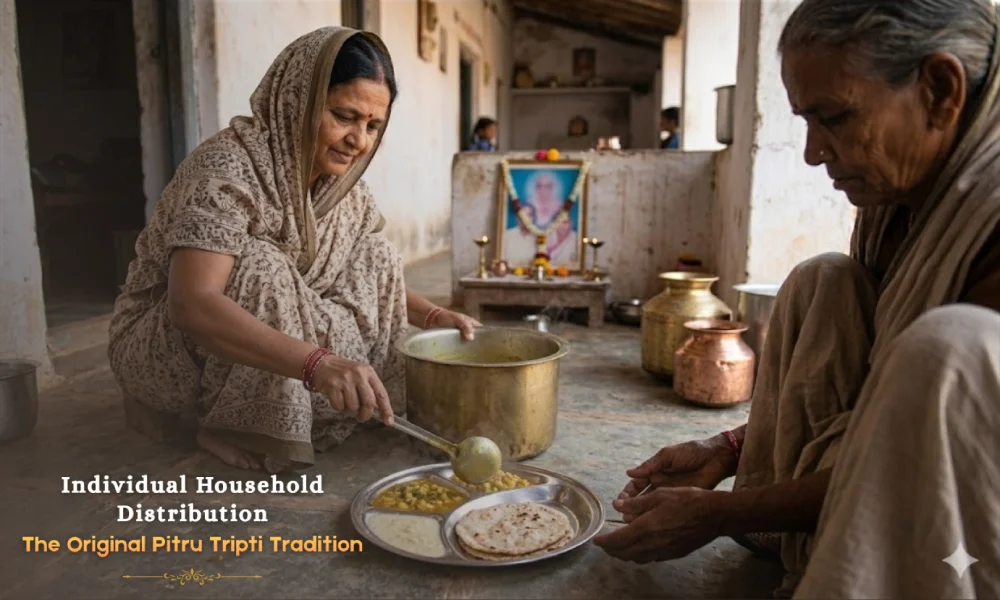
Long before institutional charity existed, individual household distribution was and remains – the foundational practice of Pitru Tripti in India. This category captures direct Brahmin bhojan, crow and cow feeding rituals, the traditional feeding of 16 Brahmins on specific tithis, home-cooked meals shared with domestic servants and neighbors, and increasingly, online Pind Daan platforms that now bundle in a linked anna daan component for digital-age convenience.
The scale of household participation is genuinely massive. An estimated 2 to 4 crore Hindu households across India perform some form of food charity during Pitru Paksha each year. Within that, the more elaborate Shodash Shradh ritual — feeding 16 Brahmins — is observed by approximately 20 to 25 lakh families annually, representing the most resource-intensive version of household-level practice.
Beneficiaries in this category reflect the ritual’s dual purpose: Brahmins and pandits who receive food as part of religious obligation, local poor populations including domestic workers, and even animals cows and crows, fed in accordance with traditional belief, alongside sadhus at neighborhood temples.
This is the most geographically distributed segment in the entire ecosystem, present across virtually every Indian household that observes Hindu ancestral rites, with the highest density in Uttar Pradesh, Bihar, Rajasthan, Maharashtra, West Bengal, Madhya Pradesh, and Odisha states with strong Sanatani ritual continuity.
Financially, the average household spends between ₹500 and ₹5,000 for a complete Shradh meal, factoring in food, offerings, and ritual materials. Scaled across the full participating population, aggregate household anna daan value is estimated at ₹800 crore to ₹1,200 crore annually combining both in-kind contributions and purchased ingredients.
This household layer is arguably the true backbone of Pitru Tripti tradition: unstructured, deeply personal, and entirely sustained by individual faith rather than institutional design the original model every NGO and trust ultimately scaled from.
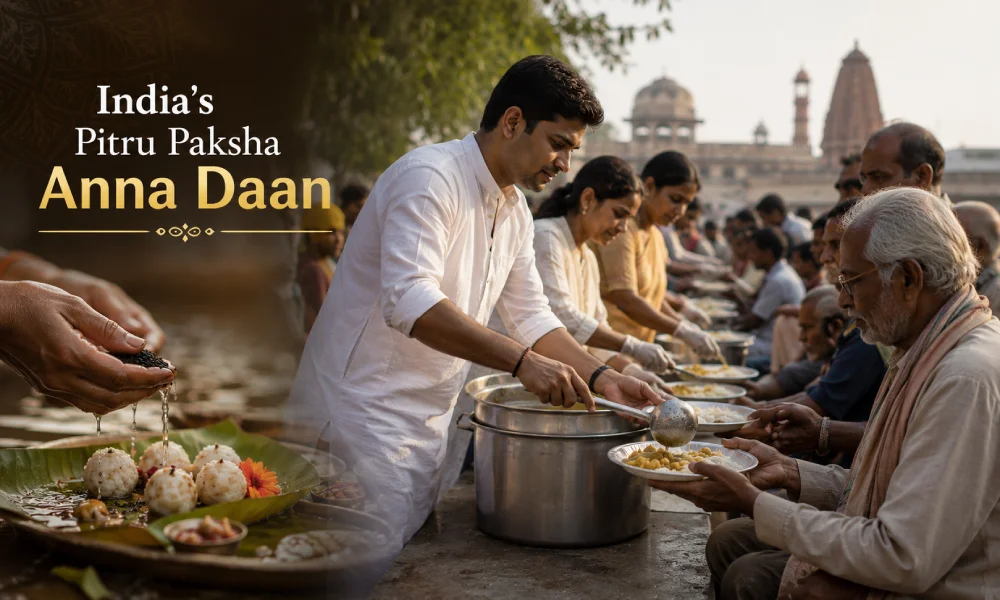
Major Religious Trusts – The Backbone of India’s Pitru Paksha Anna Daan
Discover how India’s major temple trusts like TTD, Vishnupad, and Kashi Vishwanath power the country’s largest ancestor-feeding charity network during Pitru Paksha.